Funding & Bid Director
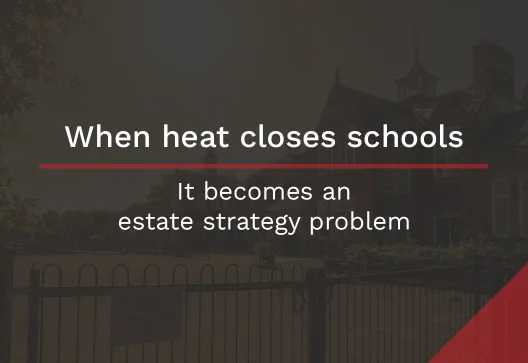
Last month, more than 1,000 schools across the UK were forced to close fully or partially as record-breaking temperatures pushed classrooms beyond safe operating conditions.
What this did was expose a much bigger issue. It wasn't simply an unfortunate consequence of an extreme weather event. What became evident is something that those working across the education estate have understood for quite some time, and that is that many of our school buildings were never designed for the climate we're now experiencing.
Moving from emergency response to long-term resilience
Last month, more than 1,000 schools across the UK were forced to close fully or partially as record-breaking temperatures pushed classrooms beyond safe operating conditions.
What this did was expose a much bigger issue. It wasn't simply an unfortunate consequence of an extreme weather event. What became evident is something that those working across the education estate have understood for quite some time, and that is that many of our school buildings were never designed for the climate we're now experiencing.
The National Education Union has rightly called for accelerated investment to retrofit ageing school buildings. Much of the UK's education estate consists of Victorian schools with limited insulation or post-war buildings from the 1960s and 1970s that perform poorly in both extreme heat and extreme cold.
As climate events become more frequent, we need to protect our education and keep buildings comfortable for our students.
We know that when classrooms become unusable, learning stops. We know that staff wellbeing is affected, and working parents face unexpected disruption. Sadly, school leaders are left managing operational challenges that should never have reached crisis point.
Now the conversation needs to move beyond emergency responses and towards long-term resilience. The point is that retrofitting is no longer optional. The challenge extends well beyond installing air conditioning.
Creating climate-resilient schools that are fit for purpose requires a holistic approach. This means that we need to consider building fabric improvements to reduce heat gain and improve thermal performance, and ventilation strategies that provide healthy learning environments throughout the year. Systems need to be energy-efficient so that they support both decarbonisation and operational resilience. When schools are estate planning, then they need to prioritise investment where it will deliver the greatest impact, and in their long-term asset management, they need to recognise climate adaptation as one of their core responsibilities. Importantly, these improvements support more than resilience. They contribute directly to net zero ambitions while reducing operating costs and creating healthier environments for pupils and staff.
Planning for tomorrow’s climate
It is important to plan for tomorrow's climate, not yesterday’s. Extreme heat is no longer an exceptional event. Alongside increased flooding, severe storms and colder winter extremes, it is becoming another factor that education estates must be designed to withstand.
That means capital investment decisions that are made today need to reflect the climate conditions schools will experience over the coming decades, not those for which they were originally built.
For education providers, trusts and local authorities, this presents both a challenge and an opportunity. By taking a strategic view of their estates, organisations can improve resilience, reduce carbon emissions and ensure learning environments remain safe and effective regardless of the weather outside.
The recent school closures should serve as a reminder that resilient estates are fundamental to resilient education. As estate professionals, we have a responsibility to help ensure our buildings are fit for the future, not just compliant for today.
Get in touch
If you are reviewing the resilience of your education estate, AEC Estate Consultants can help you identify climate-related risks, prioritise investment and develop a long-term Estate Strategy that supports both operational resilience and decarbonisation. Get in touch with our team to discuss how we can support your plans.