Director
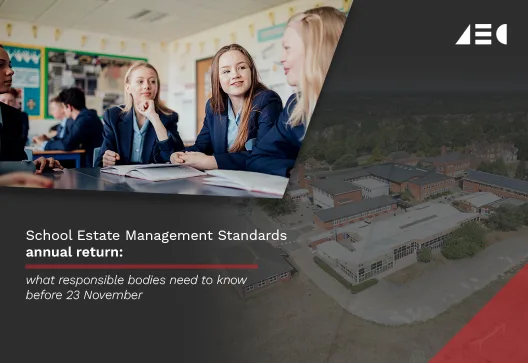
The deadline for the first School Estate Management Standards annual return is 6pm on Monday 23 November. For many responsible bodies, especially smaller trusts, it has shown how much estate information they do not yet hold. With less than two weeks to go, here is what the return is, what the levels mean and what comes next.
A desktop exercise, not an upload
The return is a multiple-choice assessment completed through the DfE’s Manage Your Education Estate service, and no supporting documents are needed this year. We see it as a desktop exercise that lets the DfE see where responsible bodies stand on their estate management duties. If bodies answer honestly, the DfE can identify who needs support well before 2028, when estate data sharing begins.
Who needs to submit
The return goes to responsible bodies eligible for capital funding. Some individual schools are in scope where they are a single academy trust. Schools in smaller MATs will most likely be expected to submit their own returns, while in larger MATs the trust itself will submit and, from 2028, share the data. Local authorities and dioceses are responsible bodies too. Most dioceses have now formed MATs, but both they and local authorities generally have more experience of the wider estate management requirements.
What we are seeing
In a word, panic. Many responsible bodies, mainly single academy trusts and smaller MATs without wider estate management experience, have not understood what the SEMS guidance asks of them. We have seen a number without the necessary documentation or information on their estate. Larger MATs usually hold most of what they need, though some are updating it.
The four levels in plain English
The standards set out four levels of estate management maturity: Baseline, Transitioning, Fully Effective and Advanced. The DfE expects schools to progress towards Level 3.
Level 1 is the baseline. It covers your basic estate management function, including the statutory requirements that tell you whether a building is safe to occupy. It requires you to have collated the core estate information and developed a plan that prioritises the estate’s needs, anticipated costs and responsibilities. Without this, you cannot accurately judge what your estate requires or plan for it.
Level 2 is about keeping it going. Once the baseline is in place, this level is about continuing to manage the estate effectively.
Level 3 is realistic for some and not others. It is more achievable for newer buildings, but the cost of putting the estate management functions in place at this level is the main limit.
Level 4 is Advanced.
Where bodies are caught out
The most common problem is not overestimating a higher level. It is underestimating Level 1. Many responsible bodies did not realise how much it asks for, or how much estate management knowledge and experience it assumes. That matters because everything else builds on it.
Why 2028 matters
By 2028, responsible bodies will be expected to share their estate data with the DfE. That will start with the Level 1 baseline and build as they develop through the levels. It is also when the Government plans to replace the Condition Improvement Fund bidding system. The information held at Level 1 will help the DfE decide where capital funding should go, so accurate, detailed estate data is essential if funding is to be allocated correctly or invitations to bid are to reach your school.
What to do now
Our advice for this week is simple. Meet the deadline, and be honest about the information you currently hold. An honest answer that shows a gap is far more useful than an optimistic one, because it is what gets you the right support. Beyond the return, make sure Level 1 is achieved and Level 2 is under way well before 2028.
How AEC can help
If you are unsure what you hold, where the gaps are or how to build the baseline, we can help. Our statutory compliance and GEMS support helps responsible bodies get the information and plans in place, and our condition surveys and asset management plans give you the data behind them. To talk through your estate, get in touch with the AEC team.
Reference: DfE, School estate management standards annual return
What is the School Estate Management Standards annual return?
It’s a short multiple-choice return that responsible bodies complete through the DfE’s Manage Your Education Estate service. Your answers show which levels of the School Estate Management Standards you currently meet, and tell the DfE how the standards are being followed and where support may be needed. 2026 is the first year it has run, and the DfE says it takes about an hour.
When is the deadline for the SEMS annual return?
The deadline is 6pm on Monday 23 November 2026. The return opened on 22 September 2026. If you can’t complete it in time, the DfE asks you to raise a service query with it.
Who needs to complete the annual return?
Responsible bodies that are eligible for annual DfE capital funding: local authorities, multi-academy trusts, single academy trusts, sixth-form colleges and dioceses. For voluntary-aided schools, the diocese completes the return and may ask the school or its governing body for input. Individual schools in a trust don’t submit their own return. Whoever submits it must hold a senior estate management role.
Do we need to upload supporting documents?
No. The return is multiple choice and doesn’t ask for documents this year. Your answers should still reflect what you hold now, because the DfE plans to introduce two-way estate data sharing with responsible bodies by 2028.
What are the four SEMS levels?
Level 1 is Baseline, Level 2 is Transitioning, Level 3 is Fully Effective and Level 4 is Advanced. Every responsible body starts at Level 1, and the DfE expects all of them to work towards Level 3. You aren’t expected to be at Level 3 already. Level 4 is optional, for organisations whose strategic aims call for it.
What does Level 1 (Baseline) require?
Level 1 is the set of essentials the DfE expects every responsible body to have in place. That means estate policies and governance documents, an estate strategy and asset management plan, a named person responsible for the estate, an up-to-date building condition survey and core estate data such as an asset register and a statutory compliance register. It also covers a health and safety policy, a fire risk assessment, a legionella risk assessment and an asbestos management survey and plan. It’s where many responsible bodies get caught out, because it asks for more than they expect.