From Funding Applications to Project Delivery: John Bailey on Managing the Estates Challenges Facing Smaller Academy Trusts

Funding & Bid Director
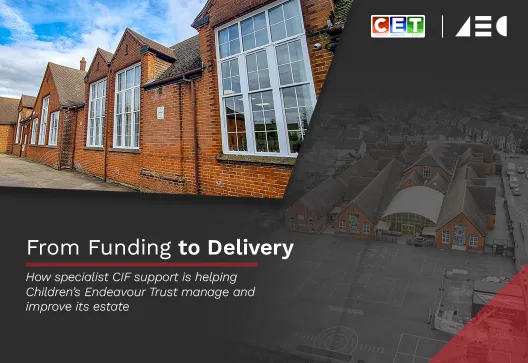
In this interview, John Bailey, Head of Operations at Children's Endeavour Trust, explains how a smaller academy trust manages its school buildings with a lean central team, and why the Trust brought in specialist estates support.
Managing School Estates and Securing Capital Funding
John Bailey, Head of Operations at Children’s Endeavour Trust, explains how the eight-school trust has approached estates management, capital funding, and major infrastructure projects, and why specialist support has become an important part of its approach.
When John Bailey joined Children’s Endeavour Trust in 2023, he brought 35 years of experience in corporate real estate with him. His new role as Head of Operations at the eight-school Suffolk-based trust presented a very different set of challenges.
With a lean central team and responsibility for maintaining a portfolio of school buildings, John quickly identified the need for additional specialist expertise, particularly in setting priorities, preparing funding applications, and managing complex estates projects.
Three years on, the Trust has secured just over £12 million in DfE financial support across around 20 projects, covering critical infrastructure and estate renewal, including electrical systems, heating, fire safety, access control and safeguarding improvements.
John explains how working with AEC Estate Consultants has helped the Trust navigate those challenges and take projects from funding application through to delivery.
You joined Children's Endeavour Trust after many years working in corporate real estate. What did you find when you took on responsibility for the Trust's estate?
I went from 500 global offices across 35 countries to eight primary schools in Suffolk. They still absorb all of my time; they just have different challenges and problems. One of the things I quickly learned was that the capital funding available annually wasn't enough to keep the buildings properly maintained, safe, dry and warm, never mind enhance anything. The Trust had also grown quite quickly, from one or two schools to eight over a relatively short period. The focus, quite rightly, had been on teaching and learning, so I didn't inherit the detailed asset registers and information I would have expected to have in a corporate environment. There were some condition surveys, but what I really needed was skilled people who could get boots on the ground, survey and assess the schools and help determine what the priorities should be.
What were the particular challenges around securing capital funding?
For a smaller trust, there is a significant amount of work involved in putting together a strong funding application. We could potentially be putting together two complex business cases for each of our eight schools, that's up to 16 applications a year. Each one can involve several thousand words, a physical performance specification, a tender exercise and pricing from potential providers. We are deliberately a lean central team, so we simply don't have the bandwidth or the spread of expertise to do all of that work ourselves. AEC brought both the resource and the specialist knowledge we needed. They understood how the Department for Education evaluates business cases and what it is looking for at any given time. That insight was extremely valuable.
What gave you confidence in AEC's approach?
I was initially quite sceptical about the no-win, no-fee model. I didn't necessarily expect the quality to be there, and I thought there might be a tendency to focus on the low-hanging fruit, the easy wins, rather than necessarily the things schools really needed. I was pleasantly surprised with AEC. They listen, they take a brief, and they are very forthright and straightforward in their advice. Sometimes that advice isn't necessarily supportive of what we initially want to do, but ultimately they deliver what we prioritise rather than simply pursuing what they think they can get funded. It's become a very balanced and complementary relationship. It really doesn't feel like a purchaser-provider relationship. It feels much more like a partnership.
What has the Trust achieved through that relationship?
Across the three years we've worked together, we've been successful in around 20 projects and secured just over £12 million in financial support from the DfE. The focus has been on critical maintenance and renewal rather than building new schools or new wings. We've had projects involving replacement electrical infrastructure, including incoming mains, distribution boards, wiring, cabling, lighting, sockets, fire alarms and safety systems. We've also had boilers and heating distribution systems renewed, fire doors and compartmentation addressed, access control improvements and safeguarding projects, including new fencing and the reconfiguration of reception areas to make them safer and more accessible. These are really important infrastructure renewal projects. Some of our schools are Victorian, and others date from the 1960s, so the infrastructure is reaching an age where it becomes increasingly difficult to maintain and potentially inherently dangerous.
How important has it been having AEC involved beyond the funding application and through to project delivery?
That's one of the things I value most. AEC effectively divides its expertise between the bid-writing side, assessing requirements, interpreting them, writing specifications and business cases and the project management team, who shortlist pre-qualified suppliers, negotiate with them and then help project manage the work through to completion. The way those two sides work together is really important. The bid writers lean on the project managers when they are putting their programmes together, while the project managers are able to feed back into the process and make sure the projects being proposed are properly thought through. That integration happens behind the scenes, and most people wouldn't necessarily see it, but it is probably the bit I appreciate most.
How much does that reduce the pressure on your own team?
A lot. If we were doing this ourselves, the number of site visits alone would be significant. Sixteen projects could potentially mean 64 site visits, before you even consider the specifications, tendering, engineering input, pricing and business cases. Our in-house role is then much more about helping schools understand why we're doing the work and managing expectations. AEC takes away the administration and management burden as well as the technical delivery. We agree on a specification and an outcome, and they go away and make it happen. That's exactly what you need in schools, because there simply isn't the funding or time to deal with everything in-house.
What difference does that make from a risk-management perspective?
Risk and value are two areas where AEC gives us a lot of assurance. There are regulatory and statutory requirements involved in managing estates projects, but there are also ongoing risks that need to be assessed and managed. A number of our projects involve identifying and disposing of asbestos wherever possible, for example, so that the whole risk profile is something we take very seriously. AEC supports us with that. They also manage the financial side of the projects. Before I pay an invoice, I receive a validation certificate confirming what work has actually been completed. If a contractor says they've completed 25% of a project, for example, it would otherwise be very difficult for a trust without quantity surveyors or engineers to assess how much value has actually been delivered. So risk and value are effectively de-risked through the process.
Why is good estates management so important to the Trust?
As a multi-academy trust, we take 125-year leases from a local authority. They are fully insuring and repairing leases, so we are responsible for handing those schools back in the same, if not better, condition than when we received them. We are custodians of public buildings, and we take that very seriously. We're also custodians of public money. If I'm recommending that a roof or windows are repaired, or that we need a new piece of equipment, we're very conscious that we're using public money and therefore need to make sound decisions. There is a balance. Headteachers quite rightly want to do what is best for their children this year, next year and the year after. We also have a responsibility to look at the condition of the buildings over the next 10, 20 or 30 years and make sure they are there for future generations of children. AEC helps us to support and represent that balance internally, and they conduct themselves extremely well whether they're talking to our Trust Board or to teachers in schools.
What would you say is the biggest difference AEC has made to the way the Trust manages its estate?
Their insight and knowledge of the way the DfE works is extremely valuable, but it is also the combination of that funding expertise with the delivery expertise. It's almost like having a design and construction management department, except I don't pay them every day. I only pay them on results. For a small trust with a lean central team, having access to that level of specialist expertise, from identifying priorities and developing funding applications through to managing the work on site, makes a significant difference. It means we can concentrate our own resources on the schools and on teaching and learning, while knowing that the estate projects are being properly assessed, funded and delivered.
What would you say to another academy trust facing similar estates challenges?
I'd say that specialist support can make a significant difference, particularly for a smaller trust where you don't necessarily have all of the expertise and capacity in-house. For us, the relationship has gone well beyond simply helping us secure funding. AEC has become an extension of the team. They understand what we're trying to achieve, they're prepared to challenge us when necessary, and they take responsibility for turning an agreed specification and outcome into a delivered project. For us, that's been extremely valuable.